


Recovering Atlantic Humpback Whale Population Bring the Giant Species Close to Home
- gemmahalstead2003
- Feb 4, 2022
- 5 min read
This blog, as I have yet to experience an upclose encounter with this beautiful species, is written with the wonderful insights of the AK Wildlife team; who have been so kind in enriching my blog, the company offer a wide range of boat trips around the South West of Cornwall, and are one of the best and most reliable ways to see some incredible British Wildlife. I will link the website at the end of this blog, where you can read all about the wonderful experiences that they offer. But, before you do that read on to expand your knowledge on these giant creatures that are ever more frequently gracing our waters.
Our AK Wildlife experts, like I'm sure you can agree are absolutely fascinated by the humpback whales. Humpback whales grow up to 60 feet (18.3 m) long and 80,000 pounds (36.3 metric tons). Humpback whales can live for 80 to 90 years. Humpback whales have some of the longest migrations of any mammal with some populations swimming 5,000 miles. Recently, a common stopping spot for the species has been in the very waters we swim in. There is something so very special about local wildlife, and when it is as rare as these encounters, the experience outdoes the likes anywhere else in world.
The team have been incredibly lucky to have seen quite a few in thier travels around the world.
Underneath is an image of a lone humpback whale, at the mouth of the Helston passage entrance, quoted as one of the AK Wildlife's "Very very best encounters."
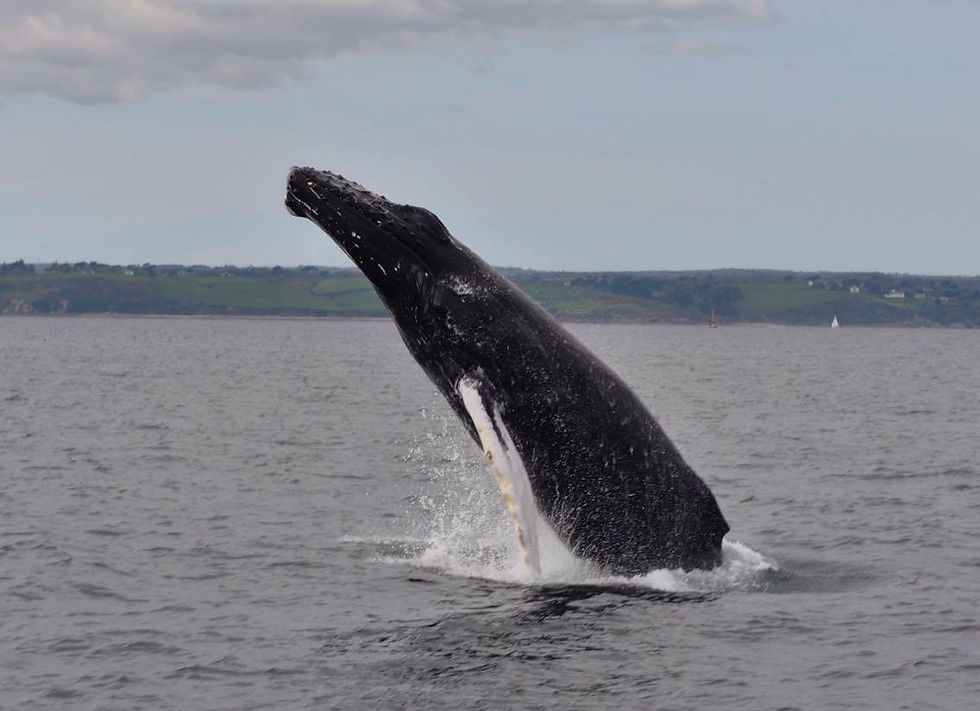
The humpback whales are 'returning to feed and passing through the rich and sheltered waters of Falmouth Bay.' Which is proof of the values of our coastal seas. Being spotted only a mile and a half from Pendennis point, if you get to view them frequently enough, it is very easy to recognise the exact whale you are viewing, as each whales fluke, dorsal fin, colour and pattern are completely unique, just like your finger print. It is believed that the humpbacks have a sense of home, and enjoy coming back to places in which they have visited on previous migrations, so perhaps we have a few resident whales.
The whale pictured in this blog, was not afraid in showing itself, breaching an incredible 25 times, for the AK Wildlife team to see. The team believe, "at the time trying to send communications to any others in the area . As these breaches were huge , resounding and incredibly audible...Double peck slapping in unison and on its back."


As perfectly worded by the AK Wildlife Team, "Joyful is this return of Humpback Whales to our Cornish seas and long may it continue."
You may be wondering the cause of the increasing returns to the Cornish water, because unlike us humans, the species aren't too bothered by the beautiful crystal clear blue waters, and impeccable fish and chips that can be enjoyed on our sandy beaches after a day spent catching the countries best waves. Instead, it is;
-The increase in numbers in the Atlantic waters.
- The big population over and off the Eastern seaboard of the USA and the population over on our side that move between Cape Verde , Gabon , and the bay of Nigeria where they breed, who then travel back North ( with calves ) and up to the cooler seas to feed. Stopping off in Cornwall on the way!
Some exciting news from the extensive, brilliant and intriguing photo ID catalogue’s out there, it’s been proven that some of the Eastern Humpies are coming across in our direction,
which all helps in mixing genes and swelling numbers over here .
The team at AK Wildlife stress the importance of the well-being and welfare of our local waters, which is the stem of and entire objective of this very blog/ project.
Part of some current research has led me to believe that the increasing humpback sightings in Cornwall are due to the increasing Herring population, as well as, as denoted by the AK Wildlife team, 'the return of BAITFISH,' in the form of both Pilchards and Herrings.
These smaller fishes, a vital and integral part of their lives were completely FISHED OUT back in the day. It’s only in the last ten years that both of these two lesser fishes have returned in small numbers to spawn and breed in the Carrick Roads, Helford estuary and our sheltered bays.' Hopefully the return of these species depicts a positive trend for the likes of the humpback whale, and that the ever special experience of getting to see one is one many of us can tick off our bucket lists.


It is absolutely vital that we aim to protect all areas of our seas, we must push to gain the upmost protection for these wonderful species and the surrounding ecosystem, and not just for our benefit of getting to see them. But, as an act of allowing nature to be as intended. As Sir David Attenborough touches upon, keeping the wild wild.
The maps below show 2021's Fin Whales (FW) and Minke Whales (MKW) plus other cetaceans. Numbering just shy of Eight Thousand cetacean individuals of the various species shown. Highlighting the great diversity of our coastal oceans.


Upon contacting AK Wildlife, is has come to my attention that there is once again a RING NET fishery within Cornwall. Ring Net Fishing is a method of fishing for target shoaling species, sadly often herring, but also sardines and anchovies. It involves the encircling of nets that are shot around a shoal. That once again is absolutely decimating this very small returning and breeding shoals. This method of fishing has once before depleted these species; one of the first experiences documented here in Cornwall is aboard the 'blaze of glory' in 1916, skipper Matin Ellis caught so many sardines that the boat sank; luckily he survived. He carried on and even promoted Cornish sardines by becoming a one-day-only chef, indeed, that day the pub at Cadgwith was awash with customers eating Cornish sardines.
A single Humpback to sustain itself … requires a good two to three tonne of these small fishes.
A single RING NETTER can happily take TWENTY TONNE in a single net !!!!!
Again, as perfectly worded by Captain Keith B Leeves of AK Wildlife Cruises, "It doesn’t take a Rocket Scientist to work out IF we allow this growing fleet of RING NETTERS to continue and expand. Once again, they will destroy this very fragile biomass and with that.
Those few building, in number Humpback Whales will have to go elsewhere to hopefully find enough food to sustain themselves.'
Sign this Petition to help stop the use of nets of this kind;
And after doing so, please take a look (if you are residing in Cornwall or planning to head this way any time soon) at the AK Wildlife Cruise experience. Pictured below is the brand boat to be launched in 2022, one that you could be on when you get to see some of our residential humpies :)


Comments